



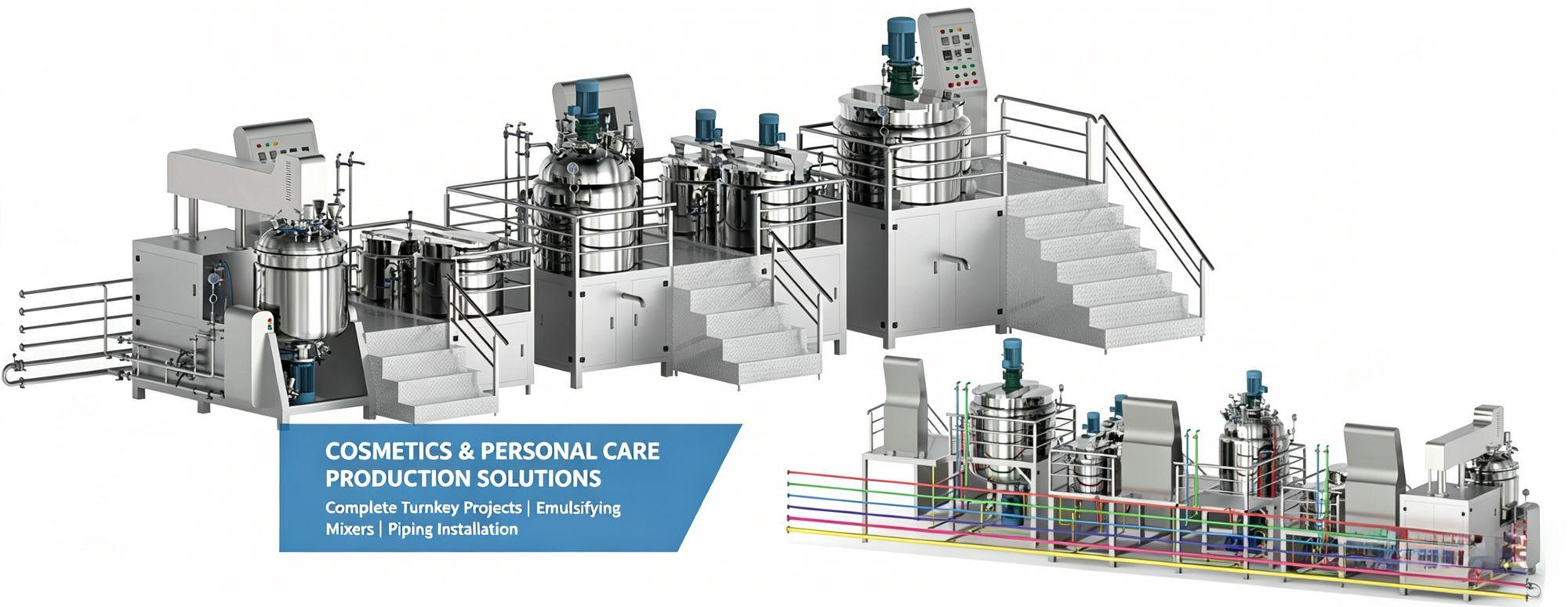


Although both ordinary mixers and vacuum emulsifiers use stirring materials to achieve complete and uniform mixing of materials, even their heating and cooling methods are the same. However, there is still a clear difference between a regular mixer and a vacuum emulsifier.
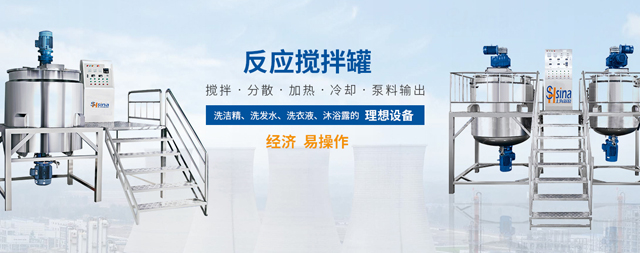
A regular mixer uses a high-power mixing motor and a mixing system composed of a frame structure, which can provide strong mixing force. The mixing of solid-liquid, solid-solid, and liquid-liquid materials requires the use of a mixer. With the slow stirring of the frame type mixing and the high-speed operation of the dispersion plate that can reach 1400rpm per minute, the materials can be fully mixed and the clustered materials can be fully dispersed to meet the technical requirements of the materials. A mixer can stir materials with a viscosity of 100000cps~1800000cps, so it is also commonly used for stirring and mixing of adhesives.
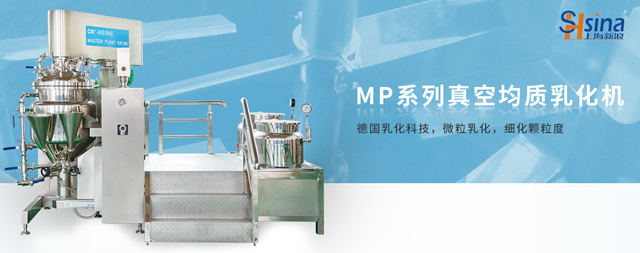
Vacuum emulsifiers are generally equipped with smaller motors, which have a relatively fast speed, and due to the use of mechanical seals as sealing devices, the stirring force is not very strong. Vacuum emulsifier is mainly used for stirring liquid liquid, solid liquid and other materials, and its material viscosity usually does not exceed 100000 cps. The kettle of the vacuum emulsifier is equipped with a homogenizing head, which can quickly cut the material, making it fully refined. After vacuuming and defoaming, the produced material has delicate and smooth characteristics. Moreover, the material particles of its final product can reach the nanometer level, and if applied to human skin, they will be quickly absorbed by the skin. Therefore, vacuum emulsifiers are commonly used in the production of dilute materials such as cosmetics, creams, and pharmaceutical creams.